Description
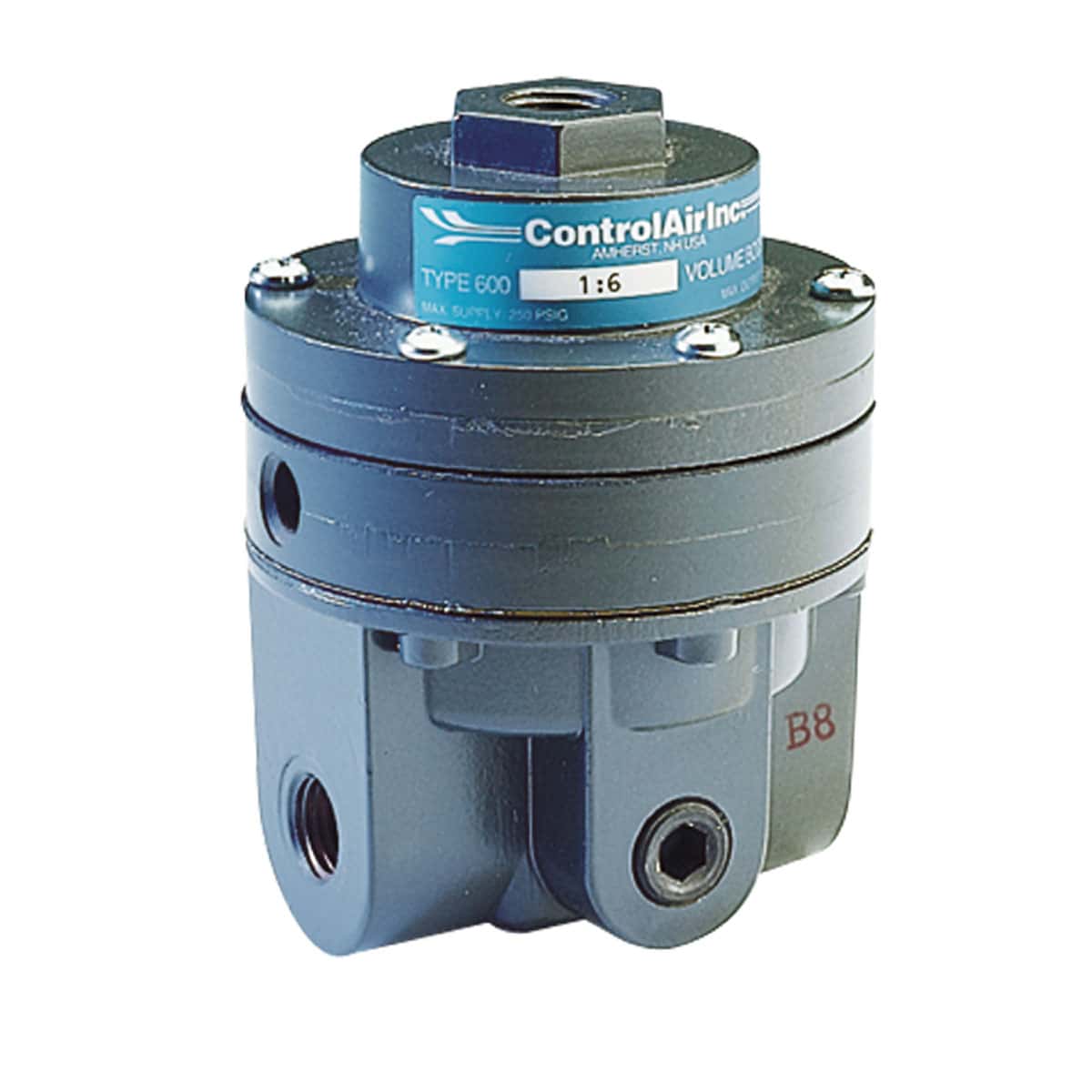
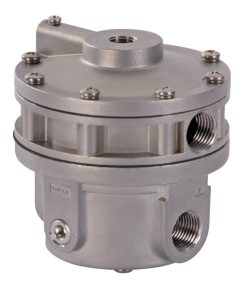
ControlAir Type 600 precision ratio-relay volume booster
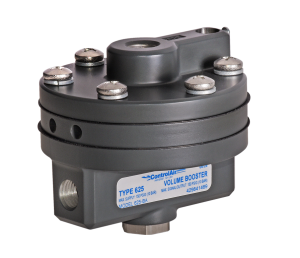
ControlAir Type 600 uses a low-flow pneumatic pilot signal and an independent air supply to deliver a higher-flow outlet. Different from the fixed 1:1 Type 625, Type 600 can alter outlet pressure relative to the signal through the selected ratio.
Key Product Details
- Supplier: ControlAir
- Manufacturer model: Type 600
- Store SKU: Type 600
- Product type: precision ratio-relay volume booster
- Distinguishing details: 1:1 standard; alternative amplifying/reducing ratios
- Product category: Pneumatic Volume Boosters
Type 600 operation
A balanced supply valve and rolling diaphragm help resist inlet pressure changes. When pressure amplification or reduction is required, check the chosen factory ratio and its separate maximum signal-pressure limit against the actuator’s needs.
Type 600 ratio selection
The allowable signal ceiling changes with the factory pressure ratio. The supplier quotes 150 psig for a 1:1 unit, falling to 75, 50 and 25 psig for the 1:2, 1:3 and 1:6 amplifying versions respectively. A Venturi aspirator and balanced valve support pressure control as airflow changes. Choose the desired outlet pressure and the pilot’s highest possible signal together; increasing the amplification factor without checking that ceiling can lead to an invalid selection.
Technical specifications
Function: Independent supply amplifies pneumatic signal flow
Signal-to-output ratios: 1:1 standard; 1:2, 1:3, 1:6, 2:1 or 3:1 options
Available connections: 1/4, 3/8 or 1/2 inch NPT or specified BSPP
Maximum supply pressure: 250 psig for the family
Maximum signal pressure: 150 psig for 1:1, 75 psig for 1:2, 50 psig for 1:3 or 25 psig for 1:6 ratio; confirm reducing-ratio version separately
Maximum family flow: 50 SCFM under manufacturer test conditions
Selection and use
For ControlAir Type 600, specify signal-to-output ratio, 1/4, 3/8 or 1/2 inch port option, NPT/BSPP thread and any bias or tapped-exhaust requirement. The family can reach 50 SCFM under its specified conditions; this is not a guaranteed duty point for each ratio.
Feed a suitably regulated supply separately from the pilot, connect the outlet to the valve or cylinder, and verify exhaust and ratio behaviour before operating the load.
Due to the technical nature of this product, please contact our sales team on 01342 826488 or email info@aegroup.uk.com if you have any questions.
Lead Time
Product Availability
We work with a wide network of trusted manufacturers and suppliers to offer a comprehensive range of industrial components and systems. Many popular items are held in stock and available for prompt dispatch. These products are supplied directly from our UK facilities where possible to minimise lead times.
Order In and Made to Order Items
Some specialist products are not held as off the shelf stock. These items are ordered directly from the manufacturer and may be produced to order or configured for specific applications. As a result, lead times can be longer than standard stocked products, particularly for low volume or unique items. Lead times will vary depending on supplier schedules and production requirements.
Lead Times and Order Updates
For all order in products, we aim to provide clear lead time information at the point of order or shortly afterwards. Our team will keep you informed throughout the process and will advise if supplier lead times change. If you have a time critical requirement, we recommend contacting us before placing your order so we can confirm availability.
Delivery Charges
Additional delivery charges may apply to large orders, oversized items, palletised shipments, or deliveries outside the UK mainland including remote locations. Our sales team can confirm any applicable charges either before or after your order is placed to ensure full transparency.
Availability and Lead Time Enquiries
For the latest information on product availability and current lead times, please contact our team directly. We will confirm stock status, supplier lead times, and delivery expectations to support your ordering decision. You can email info@aegroup.uk.com or call +44 (0)1342 826488 to speak with a member of our team who can assist with your enquiry.
More Than Components
Experts you can trust. Technologies you can depend on.
Air Engineering Group is more than a component supplier. We operate as an engineering partner supporting customers from concept through to long term operation. Our role extends beyond product supply into system design, integration, build, installation, and lifecycle support. This approach allows us to solve complex technical challenges while improving reliability, efficiency, and operational assurance across demanding industrial environments.
Our OEM Fluid Technology Division focuses on engineered solutions for original equipment manufacturers. We support customers with design input, component selection, manifold assemblies, sub assemblies, and fully integrated pneumatic and fluid systems. Working closely with OEM teams, we help reduce complexity, improve performance, and accelerate development while maintaining consistency from prototype through to production.
The Compressed Air and Gas Division delivers complete compressed air and gas solutions for industrial and commercial applications. This includes system design, equipment supply, installation, commissioning, servicing, and ongoing maintenance. By taking responsibility for the full system, we help customers improve uptime, control energy use, and protect critical assets throughout their operational life.
Our Pneumatic and Fluid Product Division provides a comprehensive range of valves, actuators, regulators, filtration, fittings, and control components. Supported by in house technical expertise, this division ensures customers specify the correct products for their application while benefiting from reliable supply and informed engineering support. Together, these three divisions position us as a complete engineering solutions provider rather than a simple distributor.
Our approach to business is built around a clear customer first focus supported by engineering integrity and accountability. We take time to understand each application, operating environment, and performance requirement before recommending or designing a solution. This ensures customers receive systems and components that deliver reliability, efficiency, and long term value rather than short term fixes. Through clear communication, responsive support, and consistent technical standards, we build trusted partnerships that prioritise uptime, risk reduction, and operational confidence.
Speak to our engineering team by emailing info@aegroup.uk.com or call +44 (0)1342 826488 to speak with a member of our team who can assist with your enquiry.
Applications & Integrations
Applications
ControlAir Type 600 (SKU Type 600) repeats a control pressure into a higher-volume pneumatic output for a diaphragm or piston actuator that responds too slowly to the original signal source alone. It is a pneumatic volume booster, not a source of new compressed air or an electronic converter. The chosen Type 600 configuration must match the controlled pressure range and necessary dynamic response. Where the valve stem movement is slow, compare the positioner’s small pilot output with the larger actuator chamber volume. The Type 600 can relieve that flow bottleneck without substituting for the positioning instrument. The actuator rather than the pilot source receives the increased airflow.
Integrations
Connect a pneumatic control signal to the Type 600 pilot inlet, a separately regulated compressed-air supply to its supply port and the higher-flow output to the receiving actuator. Select the factory signal-to-output ratio, port threads and optional tapped exhaust from the completed model code. Check the actuator’s required pressure against available supply and the chosen ratio; an amplifying ratio cannot produce an outlet pressure beyond the supplied air. Size outlet tubing for the actuator’s air volume and keep the exhaust path clear. During commissioning, compare pilot and outlet pressures at several command points and observe both filling and venting with the actual load connected. Check plant-air pressure during movement if the expected response is not achieved.