

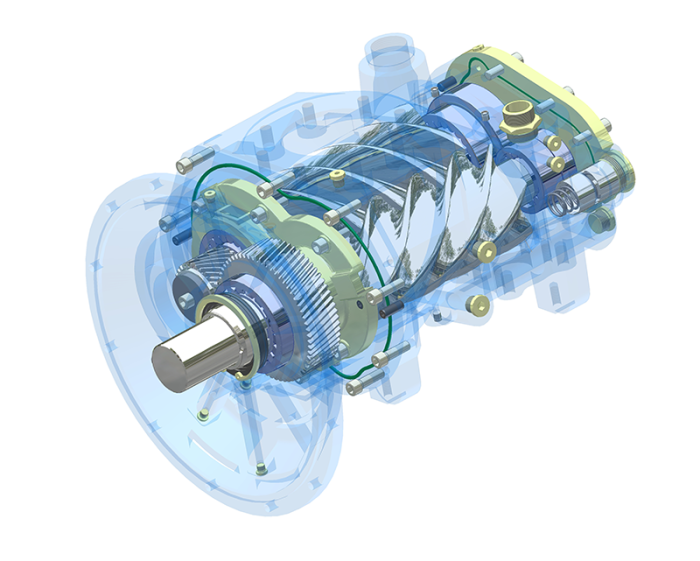
How do rotary screw air compressors work?
In modern industrial machinery, the rotary screw compressor stands out as one of the most prevalent technologies. These compressors, known for their reliability and versatility, power numerous industrial processes and applications. They handle demanding tasks across various industries, ensuring operational efficiency worldwide.
Air compressors employ two fundamental compression principles. One of these principles is positive displacement, with screw compressors being the most popular type utilizing this method.
Operating Principles
Rotary screw compressors, as their name implies, employ rotary movements to compress air. Inside the compressor, a set of male and female rotors, each designed differently, trap air between them as they rotate together. The male rotor has convex lobes, while the female rotor has concave cavities, allowing them to mesh without physical contact, achieving compression. Furthermore, the male rotor has fewer lobes than the female rotor, causing it to rotate faster, driving the female rotor.
In contrast to piston compressors, which utilize the same compression principle, screw compressors lack valves. This absence enables them to operate at high shaft speeds, avoiding mechanical or volumetric losses that can lead to imbalance. Consequently, screw technology combines a substantial flow rate with a compact, space-efficient design.
Learn more about air compressors