Description
Product Overview
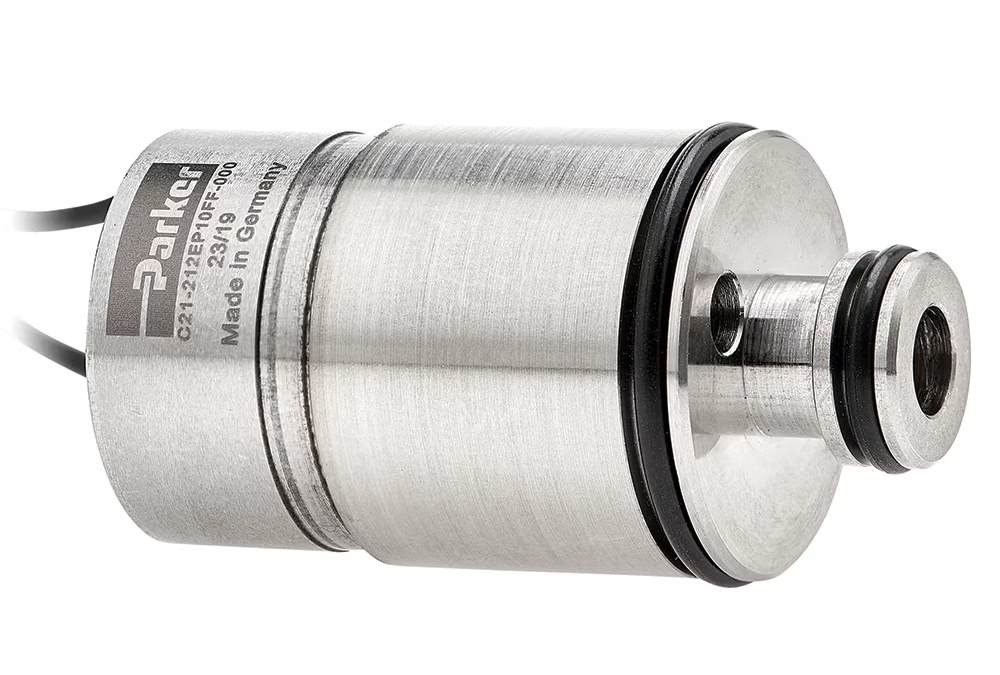
Parker C21-224EP40FF-000 combines a 24 VDC coil, EPDM internal and external seals and a 4.0 mm flow path in the 21 mm C21 cartridge format. Its 4.0 mm orifice is the largest C21 liquid passage and provides the range’s highest nominal Cv at 0.18. Parker publishes a 3630 SCCM water-flow value and a maximum operating pressure of 29 psi (2 bar). It is configured for normally closed isolation in equipment using a 24 VDC control supply.
The valve is 2-way normally closed. With the coil de-energised, the supply and outlet remain isolated. Applying 24 VDC lifts the frictionless floating plunger and opens the liquid path. This model uses a 2.5 W coil with 235 Ω nominal resistance at 20°C. The voltage and resistance tolerances are ±5%, and electrical connection is through two 80 mm, 24 AWG flying leads stripped at the ends.
How C21-224EP40FF-000 Differs
- Voltage counterpart: C21-212EP40FF-000 retains the EPDM seals, 4.0 mm orifice, 2 bar pressure limit, Cv 0.18 and 3630 SCCM water-flow value. It changes the coil to 12 VDC, 2.6 W and 56 Ω, compared with this model’s 24 VDC, 2.5 W and 235 Ω.
- Elastomer counterpart: C21-224FK40FF-000 changes the internal and external seals from EPDM to FKM without changing the published hydraulic or electrical values. EPDM carries the more favourable listed ratings for methanol, ethanol and acetonitrile, while FKM carries the more favourable listed rating for toluene.
- Orifice comparison: C21-224EP30FF-000 uses a 3.0 mm passage rated at 58 psi (4 bar), Cv 0.13 and 3770 SCCM water flow. This model uses 4.0 mm, 29 psi (2 bar), Cv 0.18 and 3630 SCCM.
Technical Specifications
- Valve function: 2-way normally closed solenoid cartridge valve
- Orifice: 0.160 inch (4.0 mm)
- Maximum operating pressure: 29 psi (2 bar)
- Nominal Cv and published water flow: 0.18 and 3630 SCCM
- Coil: 24 VDC ±5%, 2.5 W, 235 Ω nominal resistance at 20°C
- Electrical connection: two 80 mm, 24 AWG flying leads with stripped ends
- Wetted construction: stainless steel body with EPDM internal and external seals
- Performance: 10 ms maximum cycling response and up to 20 million cycles at 0.90 reliability and 95% confidence
- Envelope: 21 mm diameter, 39 mm length, 60 g weight and 1173 µL internal volume
- Filtration and temperature: 10 µm recommended filtration, 0 to 50°C operating environment and -40 to 70°C storage range
Application and Integration
Parker C21-224EP40FF-000 can be evaluated for low-pressure wash delivery, waste removal, print-fluid control, rinse manifolds and compact circuits that favour the largest available opening. Choose this model for lower-pressure duties that benefit from the largest passage and highest nominal Cv. Compare the 3.0 mm version when the highest published water-flow value or a 4 bar limit is required. The 2 bar limit makes pressure verification especially important during pump transients, valve switching and blocked-outlet conditions. Treat the maximum pressure as the governing selection limit and review the water flow curve at the intended pressure differential.
The cartridge installs into a machined face-seal cavity with both O-rings fitted. Use only a compatible insertion lubricant such as alcohol or DI water where the process permits, keep insertion force within 200 N and retain the valve at the indent around the middle of the body. Retaining the upper body can allow working pressure to load the valve incorrectly. Route and support the flying leads so handling loads do not reach the coil termination. Parker’s abbreviated chart rates EPDM as excellent with DI water, methanol, isopropanol, ethanol, acetonitrile, MEK, dilute organic acids, dilute non-organic acids, dilute bases, saline, 12% bleach and 20% sodium hydroxide. It is not recommended for tetrahydrofuran or toluene. Confirm the complete formulation, concentration, temperature, exposure time and cleaning cycle before release.
Power Reduction and OEM Support
Optional hit-and-hold control can apply full rated voltage for at least 100 ms, then reduce the hold level to 50% of rated voltage. Parker lists a minimum PWM frequency of 1 kHz and a nominal hold duty cycle of 50%. Validate the final control settings under the actual pressure, vibration, shock and temperature conditions.
Air Engineering Group (AEG) can help compare C21 orifice, voltage and elastomer options, review manifold cavity and retention details, and support prototype or production integration. AEG can supply the valve as an individual component or as part of a developed fluid-control assembly. For selection support, call 01342 826488 or email info@aegroup.uk.com.
Brand
Parker
Parker Hannifin develops precision fluid control valves for OEM equipment that requires compact dimensions, reliable switching and efficient electrical control. Its extensive portfolio includes miniature pneumatic solenoid valves, proportional flow valves, cartridge valves and diaphragm isolation valves for controlling gases and liquids. Available configurations support pressure and vacuum switching, proportional flow control and media isolation, with options for manifold, PCB and tube integration.

Parker valve technologies are used within respiratory equipment, anaesthesia systems, patient monitoring devices, diagnostic instruments, laboratory automation and other medical or life science equipment. AEG helps OEM customers select the appropriate valve function, pressure range, flow capacity, voltage, materials, elastomer and connection method, before integrating the selected components into custom manifolds, pneumatic assemblies or complete fluid control solutions.
Lead Time
Product Availability
We work with a wide network of trusted manufacturers and suppliers to offer a comprehensive range of industrial components and systems. Many popular items are held in stock and available for prompt dispatch. These products are supplied directly from our UK facilities where possible to minimise lead times.
Order In and Made to Order Items
Some specialist products are not held as off the shelf stock. These items are ordered directly from the manufacturer and may be produced to order or configured for specific applications. As a result, lead times can be longer than standard stocked products, particularly for low volume or unique items. Lead times will vary depending on supplier schedules and production requirements.
Lead Times and Order Updates
For all order in products, we aim to provide clear lead time information at the point of order or shortly afterwards. Our team will keep you informed throughout the process and will advise if supplier lead times change. If you have a time critical requirement, we recommend contacting us before placing your order so we can confirm availability.
Delivery Charges
Additional delivery charges may apply to large orders, oversized items, palletised shipments, or deliveries outside the UK mainland including remote locations. Our sales team can confirm any applicable charges either before or after your order is placed to ensure full transparency.
Availability and Lead Time Enquiries
For the latest information on product availability and current lead times, please contact our team directly. We will confirm stock status, supplier lead times, and delivery expectations to support your ordering decision. You can email info@aegroup.uk.com or call +44 (0)1342 826488 to speak with a member of our team who can assist with your enquiry.
More Than Components
Experts you can trust. Technologies you can depend on.
Air Engineering Group is more than a component supplier. We operate as an engineering partner supporting customers from concept through to long term operation. Our role extends beyond product supply into system design, integration, build, installation, and lifecycle support. This approach allows us to solve complex technical challenges while improving reliability, efficiency, and operational assurance across demanding industrial environments.
Our OEM Fluid Technology Division focuses on engineered solutions for original equipment manufacturers. We support customers with design input, component selection, manifold assemblies, sub assemblies, and fully integrated pneumatic and fluid systems. Working closely with OEM teams, we help reduce complexity, improve performance, and accelerate development while maintaining consistency from prototype through to production.
The Compressed Air and Gas Division delivers complete compressed air and gas solutions for industrial and commercial applications. This includes system design, equipment supply, installation, commissioning, servicing, and ongoing maintenance. By taking responsibility for the full system, we help customers improve uptime, control energy use, and protect critical assets throughout their operational life.
Our Pneumatic and Fluid Product Division provides a comprehensive range of valves, actuators, regulators, filtration, fittings, and control components. Supported by in house technical expertise, this division ensures customers specify the correct products for their application while benefiting from reliable supply and informed engineering support. Together, these three divisions position us as a complete engineering solutions provider rather than a simple distributor.
Our approach to business is built around a clear customer first focus supported by engineering integrity and accountability. We take time to understand each application, operating environment, and performance requirement before recommending or designing a solution. This ensures customers receive systems and components that deliver reliability, efficiency, and long term value rather than short term fixes. Through clear communication, responsive support, and consistent technical standards, we build trusted partnerships that prioritise uptime, risk reduction, and operational confidence.
Speak to our engineering team by emailing info@aegroup.uk.com or call +44 (0)1342 826488 to speak with a member of our team who can assist with your enquiry.
Applications & Integrations
Largest Orifice and Highest Nominal Cv
Parker C21-224EP40FF-000 is suited to evaluation in low-pressure wash delivery, waste removal, print-fluid control, rinse manifolds and compact circuits that favour the largest available opening. Its normally closed action stops liquid flow when electrical power is removed. The 4.0 mm passage is rated at 29 psi (2 bar) with nominal Cv 0.18 and a 3630 SCCM published water-flow value. Choose this model for lower-pressure duties that benefit from the largest passage and highest nominal Cv. Compare the 3.0 mm version when the highest published water-flow value or a 4 bar limit is required.
24 VDC EPDM Control
The 24 VDC coil is rated at 2.5 W with 235 Ω nominal resistance at 20°C. It suits a 24 VDC control architecture while retaining EPDM at both sealing interfaces. This version suits 24 VDC machine and instrument control architectures. Confirm the output stage, suppression method and lead routing for the installed valve bank. Optional hit-and-hold control can use a full-voltage pulse of at least 100 ms followed by a validated hold level based on 50% rated voltage. This can reduce heat and continuous power demand in multi-valve instruments.
Seal and Media Review
This model is intended for aqueous reagents, alcohol-based process fluids and analyser wash circuits covered by the published compatibility screening chart. Parker’s abbreviated chart rates EPDM as excellent with DI water, methanol, isopropanol, ethanol, acetonitrile, MEK, dilute organic acids, dilute non-organic acids, dilute bases, saline, 12% bleach and 20% sodium hydroxide. It is not recommended for tetrahydrofuran or toluene. Confirm the complete formulation, concentration, temperature, exposure time and cleaning cycle before release. The compatibility chart is a screening guide, so final validation remains specific to the complete fluid path.
Manifold Integration
The 21 mm diameter by 39 mm cartridge occupies 1173 µL and is supplied with EPDM O-rings installed. Machine the cavity to Parker’s dimensional recommendations, use compatible lubrication, limit insertion force to 200 N and retain the body at its middle indent. Specify 10 µm filtration, support the two 80 mm leads and keep the operating environment within 0 to 50°C.