Description
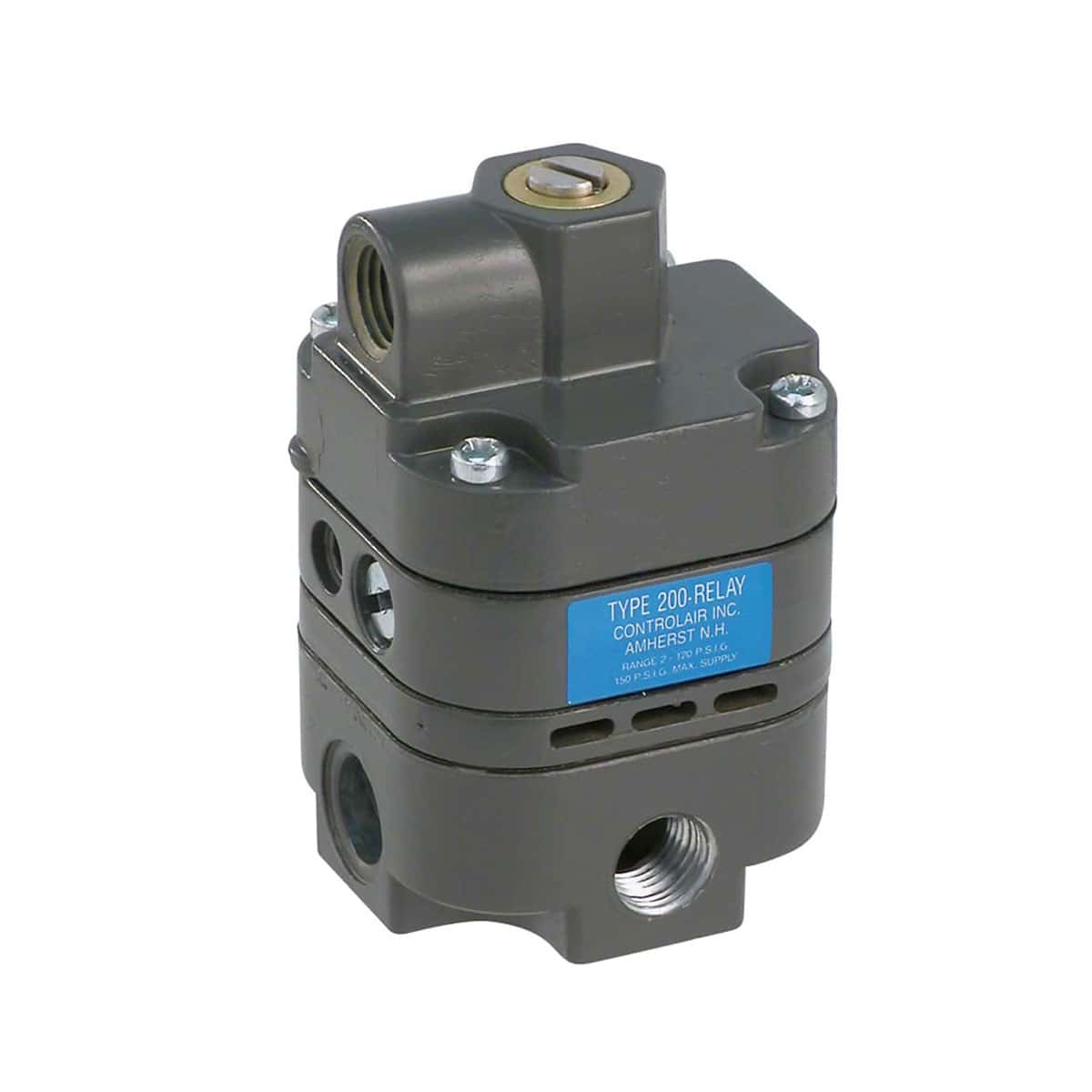
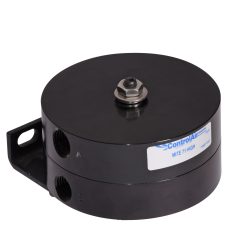
ControlAir Type 200 precision pilot-operated air relay
ControlAir Type 200 reproduces a pneumatic pilot signal with a controlled one-to-one pressure relationship. The Type 200 concentrates on fine pressure reproduction, rather than the much higher actuator flows addressed by Type 7150.
Key Product Details
- Supplier: ControlAir
- Manufacturer model: Type 200
- Store SKU: Type 200
- Product type: precision pilot-operated air relay
- Distinguishing details: 1:1 pressure relay; selectable positive/negative bias
- Product category: Air Relays
Type 200 operation
The multistage servo-balanced mechanism uses a sensitive stainless steel measuring capsule. Positive or negative bias configurations can offset output from the incoming signal.
Type 200 adjustment and relief
The standard relay has an internal bias adjustment. Type 200EB makes that adjustment external, while separate HR and EHR versions increase exhaust capacity when the receiving volume must vent more quickly. The base Type 200 supplies pilot bleed air and therefore has a 2 psig minimum regulated outlet; it cannot regulate down to zero. Select the relief variant from the required pressure-fall response, independently of forward supply flow.
Technical specifications
Signal ratio: 1:1 pilot-operated air relay with adjustable positive or negative bias
Output range: 2 to 120 psig
Maximum supply: 150 psig; maximum signal 120 psig
Bias range: -30 to +100 psig within the permitted output range
Connections: 1/4 or 3/8 inch NPT, with BSP variants available
Bias adjustment: internal on standard Type 200; external on Type 200EB
Exhaust capacity: 3 SCFM standard, 11 SCFM HR or 15 SCFM EHR under supplier test conditions
Operating temperature: -29°C to 71°C
Selection and use
For ControlAir Type 200, choose the required bias adjustment, pressure span, relief arrangement and complete manufacturer ordering code. Internal bias adjustment is standard for the base Type 200, with external bias and greater relief available on separate variants.
Connect the signal to the pilot and an adequately regulated supply to the supply port. Check the outlet against the intended downstream regulator or actuator pressure and allow access for calibration.
Due to the technical nature of this product, please contact our sales team on 01342 826488 or email info@aegroup.uk.com if you have any questions.
Lead Time
Product Availability
We work with a wide network of trusted manufacturers and suppliers to offer a comprehensive range of industrial components and systems. Many popular items are held in stock and available for prompt dispatch. These products are supplied directly from our UK facilities where possible to minimise lead times.
Order In and Made to Order Items
Some specialist products are not held as off the shelf stock. These items are ordered directly from the manufacturer and may be produced to order or configured for specific applications. As a result, lead times can be longer than standard stocked products, particularly for low volume or unique items. Lead times will vary depending on supplier schedules and production requirements.
Lead Times and Order Updates
For all order in products, we aim to provide clear lead time information at the point of order or shortly afterwards. Our team will keep you informed throughout the process and will advise if supplier lead times change. If you have a time critical requirement, we recommend contacting us before placing your order so we can confirm availability.
Delivery Charges
Additional delivery charges may apply to large orders, oversized items, palletised shipments, or deliveries outside the UK mainland including remote locations. Our sales team can confirm any applicable charges either before or after your order is placed to ensure full transparency.
Availability and Lead Time Enquiries
For the latest information on product availability and current lead times, please contact our team directly. We will confirm stock status, supplier lead times, and delivery expectations to support your ordering decision. You can email info@aegroup.uk.com or call +44 (0)1342 826488 to speak with a member of our team who can assist with your enquiry.
More Than Components
Experts you can trust. Technologies you can depend on.
Air Engineering Group is more than a component supplier. We operate as an engineering partner supporting customers from concept through to long term operation. Our role extends beyond product supply into system design, integration, build, installation, and lifecycle support. This approach allows us to solve complex technical challenges while improving reliability, efficiency, and operational assurance across demanding industrial environments.
Our OEM Fluid Technology Division focuses on engineered solutions for original equipment manufacturers. We support customers with design input, component selection, manifold assemblies, sub assemblies, and fully integrated pneumatic and fluid systems. Working closely with OEM teams, we help reduce complexity, improve performance, and accelerate development while maintaining consistency from prototype through to production.
The Compressed Air and Gas Division delivers complete compressed air and gas solutions for industrial and commercial applications. This includes system design, equipment supply, installation, commissioning, servicing, and ongoing maintenance. By taking responsibility for the full system, we help customers improve uptime, control energy use, and protect critical assets throughout their operational life.
Our Pneumatic and Fluid Product Division provides a comprehensive range of valves, actuators, regulators, filtration, fittings, and control components. Supported by in house technical expertise, this division ensures customers specify the correct products for their application while benefiting from reliable supply and informed engineering support. Together, these three divisions position us as a complete engineering solutions provider rather than a simple distributor.
Our approach to business is built around a clear customer first focus supported by engineering integrity and accountability. We take time to understand each application, operating environment, and performance requirement before recommending or designing a solution. This ensures customers receive systems and components that deliver reliability, efficiency, and long term value rather than short term fixes. Through clear communication, responsive support, and consistent technical standards, we build trusted partnerships that prioritise uptime, risk reduction, and operational confidence.
Speak to our engineering team by emailing info@aegroup.uk.com or call +44 (0)1342 826488 to speak with a member of our team who can assist with your enquiry.
Applications & Integrations
Applications
ControlAir Type 200 (SKU Type 200) reproduces a pneumatic signal at a 1:1 ratio while allowing a separately chosen positive or negative bias to shift the output. The multistage servo-balanced relay suits remote air-pressure control or signal conditioning where the original signal source has limited flow. Its adjustable bias distinguishes it from a simple direct-air line and from the positive-bias-only Type 650 selection. The operator can create a small offset from a pneumatic command to compensate for a downstream controlled process, while keeping signal changes proportional. Select the bias sign and available adjustment range against the working span. Bias can be checked against inlet and outlet gauges during every adjustment.
Integrations
Connect clean instrument air, the pilot signal and downstream output to the selected Type 200 ports, including its designated exhaust. Select internal or optional external bias setting from the full manufacturer code and allow gauge access to compare input and output. Adjust the bias at known pressures, then test repeatability across the expected signal window; a separate regulator or gas-handling package may still be required for the larger circuit. Use a supply gauge to determine whether the relay has enough headroom to reproduce a signal plus the selected offset. A drifting source pressure can mask the correct bias setting during a static calibration.