

Valve Selection and Manifold Design for Medical Device OEMs
From your first circuit drawing to a tested manifold assembly
Air Engineering Group (AEG) works with your engineers on medical device valve selection and manifold design. We start with what the circuit needs to do, then check the required flow, operating pressures, and materials in contact with the gas or liquid. AEG develop the manifold passages, seals, and sensor connections around the selected valves, then test leakage, flow response, and repeatability against the targets we agree with your team.
You can start with a circuit sketch, a target flow, or the space available inside your device. If you already have a prototype, we can review its operating conditions and bench results together to investigate pressure losses, unstable flow, or integration difficulties and agree practical changes for the next build.
Medical device valve selection by circuit function
We start by working through your medical device circuit with you, checking what each valve port needs to do during operation and when power is removed. Our engineers then establish the lowest flow you need to control alongside the maximum demand. If the circuit handles oxygen, we review the cleanliness requirements with your team. For liquid circuits, we check the working fluid and any cleaning agents against the materials they will contact inside the valve.
Circuit requirement | Valve to consider | What to check |
Vary gas flow as the setpoint changes | Miniature proportional gas valve | Minimum controllable flow, peak demand, inlet and outlet pressures, and coil drive. |
Open or isolate a gas line | Two way on/off solenoid valve | Normal position, allowable closed valve leakage, and available pressure difference. |
Switch between paths or vent a chamber | Three way switching valve or dedicated exhaust valve | Port connections in each state, chamber volume, exhaust restriction, and venting time. |
Select a reagent or wash liquid | Diaphragm isolation valve | Wetted materials, cleaning fluid compatibility, retained volume, and allowable carryover. |
When to specify a Parker VSO proportional valve
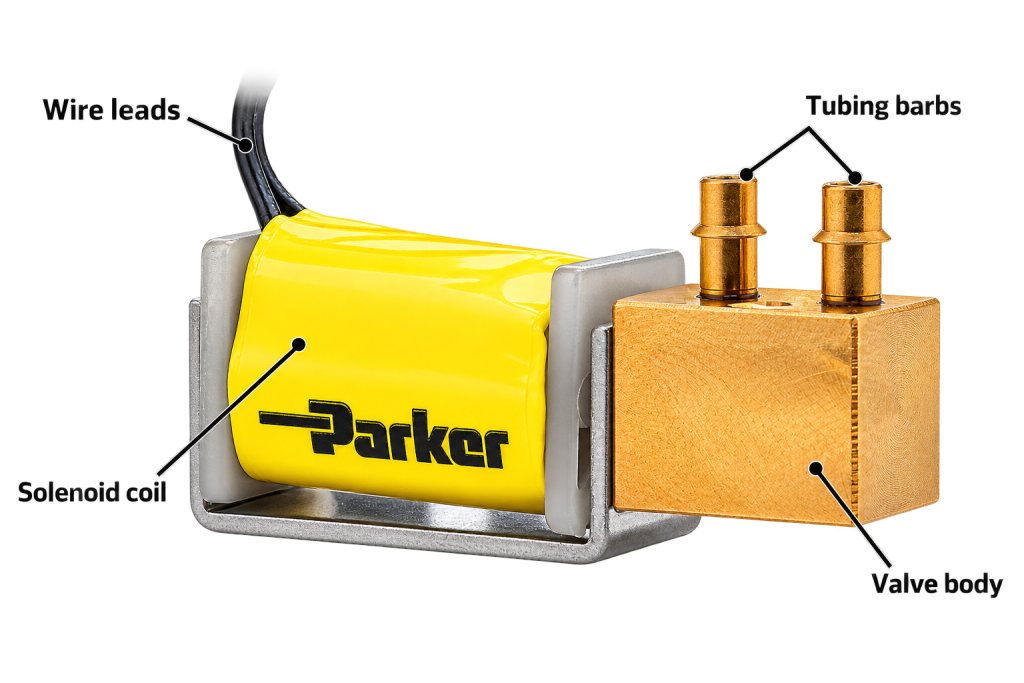
When we assess a Parker VSO for your device, we start with the required flow, gas type, and inlet and outlet pressures. The standard VSO is a normally closed, two way proportional gas valve whose opening changes with coil current. We check the orifice size and review the valve alongside your flow sensor and controller to understand how the circuit will maintain flow as supply pressure changes.
We then compare your requirements with the available VSO models. Parker lists flows up to 56 standard litres per minute for the standard family. The separate VSO Low Flow range covers up to 500 standard cubic centimetres per minute (sccm), or 0.5 standard litres per minute. We use the selected model’s flow curve to assess its operating range, paying particular attention to the lowest setpoint your device needs to hold.
How AEG integrated Parker VSO Low Flow valves for ScubaTx
Adapting an existing manifold for an organ preservation prototype
ScubaTx already had a fluidic concept for its organ preservation and transport system when we joined the project. We worked with its team to build on the existing manifold design, introduce proportional gas control, and turn the concept into a working prototype.
Our design engineers refined the manifold for manufacture, integrated Parker VSO Low Flow valves, and worked with Parker and RVL on the printed circuit board (PCB) interface. We then assembled the manifold and checked its performance against ScubaTx’s requirements. The prototype met those requirements, giving the team a tested assembly to take into the next stage of development.
Medical device manifold design for a compact enclosure
Reduce external tube joints while keeping critical test points accessible
During early prototype trials, we work through the circuit with your engineers, using separate valves and tubing where the layout still needs adjustment. As the design settles, we look at which connections can move inside the manifold. This helps us free up enclosure space, reduce the joints that need leak testing, and make the assembly easier to build consistently.
We also check that your device achieves its pressure or flow target where it matters. A sensor before a filter might show the correct pressure while the outlet falls below its target during flow. We investigate that difference with your team, reviewing sensor positions, passage sizes, and test points so we can address pressure losses before the next build.
Fluidic manifold prototyping and performance testing for medical OEMs
Before we build the prototype, we agree with your engineers what the circuit needs to achieve. For proportional gas control, we look at how low the flow must go, how much shutoff leakage is acceptable, how quickly the circuit should respond to a new setpoint, and what should happen if power is lost. We then test with the intended driver, tubing, and filters across the inlet and outlet pressures your device will encounter.
For each build, we record the valve part number, manifold drawing revision, driver settings, test conditions, and results. Your engineering and purchasing teams can then see what we tested and how it performed, giving them a clear reference as the design moves into repeat production.
Medical device valve and manifold FAQs
Q1: What does AEG need to start medical device valve selection?
A sketch, target flow, or enclosure dimensions will start the discussion. To recommend a part number, we also need the gas or liquid, pressures at both valve ports, and the required switching or control function.
Q2: Why do you need both the inlet and outlet pressure?
An inlet at 2.0 bar gauge and an outlet at 1.6 bar gauge give a pressure difference of 0.4 bar across the valve. Use both operating pressures and the manufacturer’s curve for the intended gas when checking whether a valve can deliver the required flow.
Q3: Can AEG work with our existing manifold and electronics?
Yes. Share the port and mounting drawings, together with the supply voltage or driver specification. We can review sealing faces, fixing positions, connector access, and the available drive current before proposing changes.
Q4: Which leakage limits should we specify?
Give separate limits for leakage through a closed valve seat and leakage from the assembly to its surroundings. Include the test medium, pressure difference, and units for each limit so the prototype test measures the required performance.
Q5: Can AEG supply repeat assemblies after prototype testing?
Yes. Share the prototype quantity, expected annual demand, and target build date. We can review component supply, assembly, and production testing against the design revision your team approves.
Discuss your medical device prototype with AEG
Share a circuit sketch, a target flow, or a bench test result
Email us a circuit drawing or outline your application in the enquiry form. We can work through the details with you, including the gas or liquid, required flow range, inlet and outlet pressures, and any limits on space or power.
Our OEM Fluid Technology team uses this information to help select a miniature valve and develop the manifold flow paths around your device. We also check how the valve will work with your sensors and control electronics as part of the complete circuit. If your prototype is already running, we can review the bench test results together. This helps us investigate pressure drop, leakage, or unstable flow and agree practical changes with your engineers before the next build.
Call 01342 826488 or email info@aegroup.uk.com
Matching Parker VSO valves to your prototype manifold
AEG’s OEM Fluid Technology Division can guide component selection and assembly development, considering gas compatibility, pressure differential, flow range, current drive, sensor integration, manifold sealing, filtration, and maintenance requirements.
To select a Parker VSO valve for your prototype manifold, share your schematic, gas composition, inlet and outlet pressures, and flow range. Include any drive, accuracy, or calibration requirements.
Browse the Parker VSO proportional valve range to compare models for gas flow control. Read the Parker VSO valve guide for guidance on flow rates, pressure limits, and mounting options, or explore Parker miniature valves and OEM fluid control solutions for medical, analytical, and life science equipment.
Review your prototype’s fluid control
Get guidance on Parker valve selection and manifold design for your medical device prototype. Share a part number, circuit drawing, or flow and pressure targets.
AEG’s OEM Fluid Technology team can assess valve function, media compatibility, manifold layout, and integration with sensors and controls. We work with engineering and purchasing teams through prototyping, testing, procurement, and after sales support.
Use the form to describe your device, development stage, and any space or power constraints. An initial sketch or specification is enough to start the discussion.