

Parker Ultra Low Carryover Valves for OEM Instruments
Liquid switching and carryover control for medical, analytical, and life science equipment
As a supplier of Parker precision fluid control products, Air Engineering Group (AEG) brings practical experience in specifying miniature valves for medical and analytical OEM equipment, with attention to material compatibility, electrical drive, and the assembled fluidic circuit.
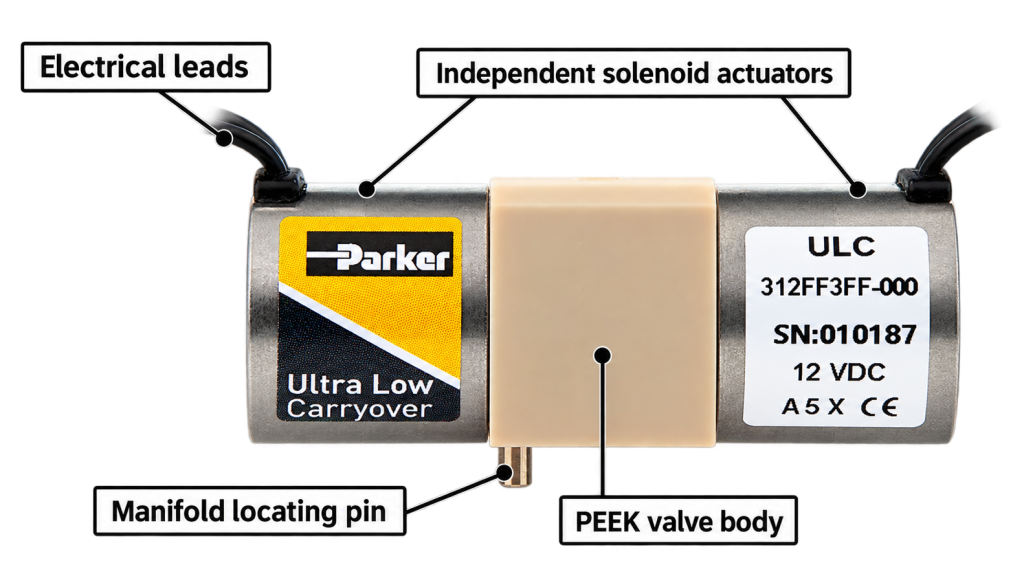
The Parker Ultra Low Carryover Valve switches liquid paths while limiting residue that can affect subsequent samples or reagents. The range includes two port shutoff and three port configurations. The three port version has two independently controlled liquid paths, providing four operating modes.
Parker identifies sampling, reagent addition, flow control, and gradient proportioning as applications. For OEM designers and procurement teams, selection should consider measured carryover, connection format, wetted materials, operating conditions, and driver requirements.
What carryover means for instrument performance
Carryover occurs when material remaining from a previous sample, reagent, or wash liquid affects the next operation. In diagnostic and analytical instruments, this can influence the measured result or increase the cleaning needed between cycles.
Lower residual liquid can reduce wash consumption and shorten cleaning sequences, provided the assembled instrument meets its acceptance criteria. Valve selection therefore needs to consider washout behaviour together with tubing, fittings, shared passages, and the sensitivity of the measurement method.
How Parker Ultra Low Carryover valves work
An electromagnetic actuator opens each normally closed liquid path when its coil is energised. The two port version provides shutoff through one controlled path. The three port version combines two independently actuated paths with a common connection, allowing either channel, both channels, or neither channel to open.
| Channel A coil | Channel B coil | Three port valve function |
|---|---|---|
| Deenergised | Deenergised | Both liquid paths closed |
| Energised | Deenergised | Channel A open to the common port |
| Deenergised | Energised | Channel B open to the common port |
| Energised | Energised | Both channels open to the common port |
Opening both channels creates a shared liquid connection. Define pressure relationships and the switching sequence to control mixing and crossflow between supplies. Actual liquid arrival also depends on pressure differential, viscosity, and the volume of the connected circuit.
Medical, analytical, and life science applications
Clinical diagnostic reagent and sample handling
Analytical chemistry is a published Parker market for the Ultra Low Carryover Valve. Its liquid switching functions can be assessed for sample admission, reagent selection, and wash routing. Measure residual liquid at the analytical measurement point, accounting for tubing, fittings, connected volume, and detection sensitivity.
Life science and laboratory automation
Potential OEM uses include buffer selection, reagent delivery, and wash circuits within laboratory automation equipment. The valve’s compact connections can help designers reduce shared fluidic volume. Evaluate each proposed use against the actual chemistry, contamination limits, operating sequence, and qualification requirements of the instrument.
Environmental monitoring and agent detection
Parker also identifies environmental monitoring and agent detection as markets. Designers can assess the valve for liquid sampling and reagent paths where contamination from a previous cycle affects subsequent measurements. Confirm compatibility with collected samples, particles, cleaning media, and the required detection method.
Analytical chemistry instruments
Analytical chemistry is a published Parker market for the Ultra Low Carryover Valve. Its liquid switching functions can be assessed for sample admission, reagent selection, and wash routing. Measure residual liquid at the analytical measurement point, accounting for tubing, fittings, connected volume, and detection sensitivity.
Why specify Parker Ultra Low Carryover valves
Documented washout performance
Parker publishes comparative carryover testing that gives designers evidence for evaluating washout behaviour. Reduced residual liquid can allow shorter cleaning sequences and lower wash consumption. Establish the required carryover threshold and test method for the instrument before converting valve performance into throughput or cost assumptions.
Four operating modes in one three port valve
The three port configuration can close both paths, open channel A, open channel B, or open both together. This gives OEM designers routing options within one valve assembly. Define channel commands, pressure relationships, and the common connection to manage mixing and unintended crossflow.
Connection choices for compact liquid circuits
Threaded and face seal versions provide different options for tubing connections and manifold integration. Published internal volumes vary between configurations, giving designers a basis for circuit assessment. Review the valve together with fittings and passages, since the entire connected volume affects flushing and liquid arrival.
Published reliability for qualification planning
Parker documents ten million cycles with a 0.95 reliability factor at a 95% confidence interval. This provides a stated qualification reference for procurement and design reviews. Instrument service life still depends on media, filtration, operating conditions, electrical drive, and the planned maintenance regime.
Select materials for process and cleaning liquids
The standard wetted material options are a PEEK body with FFKM or EPDM seals. Choose the seal against the complete liquid chemistry, including cleaning agents, concentrations, exposure time, and operating temperature.
Parker’s abbreviated compatibility chart does not recommend EPDM with tetrahydrofuran or toluene. It rates FFKM as good for tetrahydrofuran and excellent for toluene. Confirm suitability for the actual process and cleaning conditions, including every material in the connected wetted path.
Published specifications for OEM selection
Parker’s comparative washout chart shows its two three port ULC designs reaching a 10 ppm carryover threshold with less flushing than the two comparator valves tested. Its whitepaper describes dye switching and flushing with a precision syringe pump while absorbance was measured. The cleaning sequence and resulting savings still require qualification within the intended instrument.
The following values apply to the two port and three port Ultra Low Carryover valves covered by Parker’s product datasheet. Confirm the selected part and drawing before completing the instrument specification.
| Specification | Published value |
|---|---|
| Valve configurations | Two ports with two modes; three ports with four modes |
| Orifice diameter | 0.030 inch / 0.76 mm |
| Operating pressure | 45 psig / 3.1 bar |
| Water flow reference | 320 mL/min at 45 psig / 3.1 bar |
| Response time | Less than 10 ms at 20°C |
| Operating and media temperature | 4°C to 50°C |
| Wetted materials | PEEK body; FFKM or EPDM seals |
| Liquid connections | 1/4-28 threaded or face seal manifold interface |
| Coil voltages | 12 VDC or 24 VDC |
| Rated coil power | 3.0 W per coil |
| Published leakage | 0.15 sccm of air |
| Recommended filtration | 16 µm or less |
| Published reliability | Ten million cycles; 0.95 reliability factor; 95% confidence interval |
The water flow value is a reference for the stated test condition. Delivery with other liquids depends on viscosity, pressure differential, and circuit restrictions. The leakage specification uses air and should not be treated as a measured liquid leakage rate.
Internal volume depends on the configuration
Use the configuration specific figures when assessing shared liquid volume and flushing. Parker distinguishes port-to-seat volume from total port-to-port volume.
| Configuration | Port-to-seat volume | Port-to-port volume |
|---|---|---|
| Two port, 1/4-28 threaded | 4.05 µL | 14.24 µL |
| Three port, 1/4-28 threaded | 5.32 µL | 15.43 µL |
| Two port, face seal | 11.36 µL | 20.67 µL |
| Three port, face seal | 12.54 µL | 21.87 µL |
These internal volumes describe the valve geometry. They are separate from measured carryover and delivered dose. Include adjoining fittings and manifold passages when calculating the volume that the instrument must fill or flush.
The above component specifications come from Parker’s Ultra Low Carryover Valve datasheet.
Learn more about Parker Miniature Valves and Components
Integrating the valve into an OEM fluidic circuit
Qualify carryover across the assembled circuit
Define the carryover target and how it will be measured before selecting the valve. Test representative samples, reagents, and cleaning liquids through the assembled tubing, fittings, and manifold. Include liquid concentration, viscosity, temperature, pressure differential, and the sequence between samples.
Measure residual liquid at the analytical point, rather than the valve outlet alone. Assess wash volume, wash time, filtration, bubbles, and shared passages together. Validate the cleaning sequence and acceptance criteria under representative operating and maintenance conditions.
Match electrical drive to the operating sequence
Parker requires hit and hold drive when actuation exceeds 100 ms. The published method recommends a 50 ms hit at rated voltage, followed by reduced holding voltage. Assess supply capacity and enclosure temperature for the number of coils energised together.
Validate opening and release timing, holding margin, and suppression components under representative pressure and temperature conditions. For three port valves, define whether both channels may open together. Confirm connections, mounting space, and channel commands against the selected drawing before production qualification.
| Rated coil voltage | Published holding voltage | Typical holding power per coil |
|---|---|---|
| 12 VDC | 6 V | 0.7 W |
| 24 VDC | 12 V | 0.7 W |
Parker specifies a hit longer than 20 ms and no longer than 100 ms. Its recommended 50 ms hit allows the valve to open before reducing the voltage. Confirm actual driver performance and holding margin in the intended assembly.
Specify with confidence from prototype to production
the right configuration for procurement
Specify the Parker part number, port configuration, seal material, voltage, connections, and electrical drive. Include process and cleaning liquids, pressures, flow targets, carryover requirements, and mounting details.
ULC-312FF3FF-000 is a three port, 12 VDC valve with FFKM seals and face seal connections. Confirm the ordering code and drawing, as connection format affects internal volume.
For development, provide sample quantities, test methods, and qualification timescales. For production, include forecast volumes, delivery requirements, documentation, and substitution restrictions.
Assess cost alongside driver hardware, connections, assembly, qualification, and maintenance. Confirm lead times and availability. Configuration changes require engineering review.
Discuss your OEM carryover requirements
AEG’s OEM Fluid Technology Division combines medical and analytical fluid control experience with knowledge of valve specification, material compatibility, and integration. Our team can guide component selection and assembly development, considering liquid paths, operating pressures, flow, connecting volume, electrical drive, and cleaning requirements.
Share your schematic, process and cleaning liquids, concentrations, inlet and outlet pressures, required flow, carryover target and measurement method, electrical supply, temperatures, and expected quantities so we can assess your requirements and recommend suitable options.
Browse the Parker Ultra Low Carryover Valve range, or contact Air Engineering Group on 01342 826488 or email info@aegroup.uk.com to discuss your medical, analytical, or life science liquid control application.
Find the right Parker valve for your OEM medical or life science application with guidance from Air Engineering Group. Whether you have a part number, a specification, or a fluid control challenge to solve, we can help you assess suitable options and move your project forward.
From selecting and specifying valves for prototype equipment to procurement and after sales support, AEG works with your engineering and purchasing teams to clarify requirements, address integration challenges, and match valves to your application.
Tell us about your application using the form below. Share the details you have, even if your requirements are still developing, and our team will help you identify the next step.