

Parker Ultra Low Carryover Gradient Valve Applications
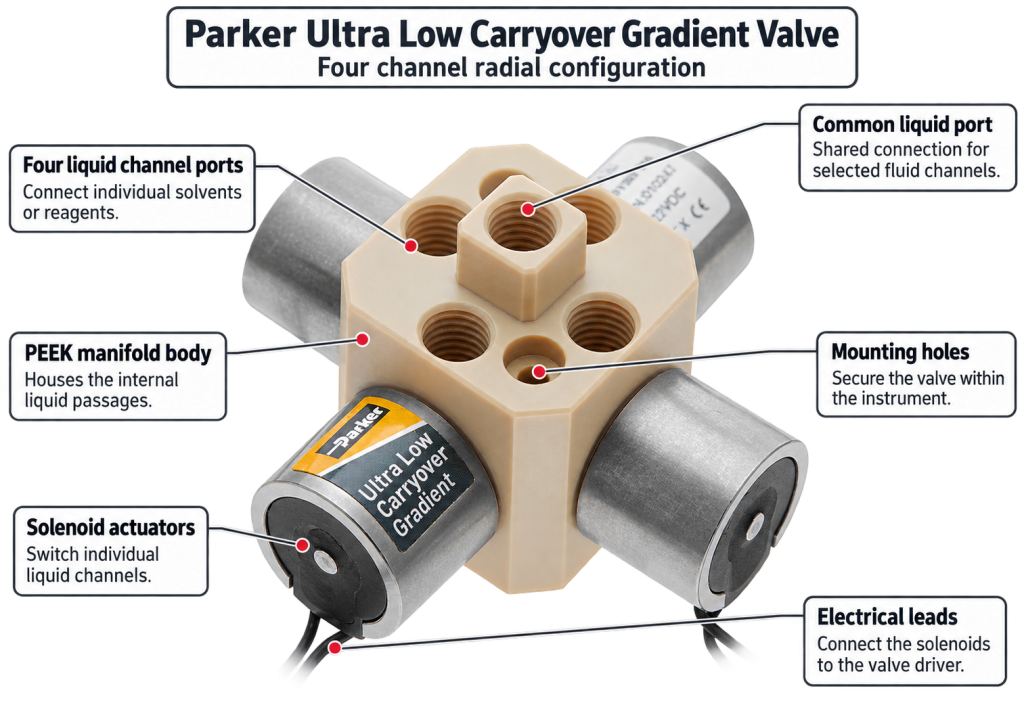
What are ultra low carryover gradient valves?
A gradient valve controls which liquid enters a shared flow path. In a proportioning system, the instrument controls channel opening times alongside the pump and mixing arrangement to produce the required solvent composition. The same valve family can also select between individual solvents or reagents.
Carryover occurs when residual liquid from an earlier flow condition enters a later one. Within a multichannel valve, retained fluid and channel crosstalk can affect the intended composition. A low volume, well swept flow path helps liquid change over efficiently.
Internal volume and carryover are related, but different. Internal volume describes the liquid held within a defined part of the valve. Carryover describes unwanted transfer of previous fluid. Actual performance also depends on the media, tubing, fittings, and flushing sequence.
In HPLC equipment, this valve range is suited to low pressure solvent proportioning and selection circuits. Its 45 psig operating rating must be considered separately from the high pressure circuit supplying the chromatographic column.
medical, analytical, and life science devices
Ultra low carryover gradient valves select and proportion liquids while limiting residual fluid transfer between channels. They are used in HPLC systems, clinical diagnostic analysers, and reagent handling equipment where changes in fluid composition need to be controlled accurately.
Air Engineering Group supplies Parker Ultra Low Carryover Gradient Valves and helps OEMs select fluid control components for medical, analytical, and life science equipment. The range combines two or four liquid channels with compact construction, low internal volume, and rapid solenoid actuation.
Where are gradient valves used?
Parker identifies HPLC, HbA1c analysis, reagent selection, and liquid distribution as applications for the Ultra Low Carryover Gradient Valve. Its stated markets include analytical chemistry, clinical diagnostics, and environmental monitoring.
For medical device OEMs, the relevant focus is diagnostic and laboratory fluid handling. Suitability depends on the instrument’s intended use and validation requirements. The valve specification alone does not establish patient contact suitability or approval of a finished medical device.
The examples below describe applications for OEM evaluation.
| Industry or device | OEM application | Design priority |
|---|---|---|
| Medical and clinical diagnostics | Solvent or reagent selection in diagnostic analysers, including HbA1c instrumentation. | Consistent fluid changes, compatible materials, and repeatable actuation. |
| Analytical instruments | HPLC gradient proportioning and solvent selection. | Accurate composition changes and controlled fluidic volume. |
| Pharmaceutical and life science laboratories | HPLC and reagent handling instruments developed for research and laboratory analysis. | Compatibility with solvents, buffers, and cleaning fluids. |
| Environmental monitoring | Analytical equipment requiring selection or distribution of liquid reagents. | Repeatable fluid routing and dependable operation over repeated cycles. |
Why specify Parker Ultra Low Carryover Gradient Valves?
Low internal volume for faster fluid changes
Parker’s design uses short fluid passages and an armature extending into the manifold body to reduce retained volume. This helps reduce fluid remaining between channel changes and supports responsive solvent proportioning.
The valve’s internal volume is one part of the wider fluidic circuit. HPLC dwell volume also includes other components between the proportioning point and the column. Reducing unnecessary connecting volume can help a programmed gradient reach the column sooner.
These volumes are specific to each configuration.
| Valve configuration | Internal volume from seal to common port | Integration consideration |
|---|---|---|
| Two channels | 4.05 µL | Two fluid channels with the lowest listed internal volume. |
| Four channels with radial body | 9.4 µL | Four fluid channels with less internal volume than the panel format. |
| Four channels with panel mounting | 12.99 µL | Panel installation can separate liquid connections from electronics. |
Rapid switching with defined electrical conditions
Parker specifies response times below 10 ms at rated voltage and below 2 ms at twice rated voltage. These conditions matter when comparing valves or designing a driver. The faster figure should be used only with an appropriate drive arrangement agreed against Parker’s requirements.
The range offers 12 or 24 VDC coils. Hit and hold control is required for actuation exceeding 100 ms. This applies an initial actuation voltage followed by a reduced holding voltage, limiting power consumption and heat while the channel remains open.
Documented durability and crystallisation resistance
The published life rating is 50 million cycles. Parker also reports that the valve continued to meet specifications after 30 million cycles with saline solution, when that test was ended.
These results provide useful evidence of durability and crystallisation resistance for OEMs evaluating repeated solvent and reagent switching in analytical and diagnostic instruments. Service life in an instrument still depends on media, contamination, actual operating conditions, and routine maintenance.
Compact options for instrument integration
Parker’s July 2021 brochure reports an 80% reduction in size and a 75% reduction in weight against the competing gradient valves used in its comparison. The two channel, radial, and panel formats also give designers different options for fitting the valve into an instrument.
The practical reason to specify Parker is the combination of low internal volume, documented switching performance, material options, and mounting formats. Evaluate those characteristics against the instrument’s requirements when selecting a variant.
Selecting a gradient valve for an OEM instrument
Start with the fluidic circuit and required operating sequence for your OEM instrument. Channel count, seal material, driver behaviour, and connecting volume can all affect the final result.
Seal selection should follow the actual fluid chemistry. For example, Parker’s abbreviated compatibility chart does not recommend EPDM with tetrahydrofuran or toluene. Review the entire wetted path, including connecting tubing, and confirm suitability using the intended operating and cleaning conditions.
| Selection factor | What to confirm |
|---|---|
| Fluid compatibility | Check every process and cleaning fluid against the PEEK body and selected FFKM or EPDM seals, including concentration and temperature. |
| Operating conditions | Confirm inlet and outlet conditions against the 45 psig, approximately 3.1 bar, operating pressure and 4 °C to 50 °C media and ambient temperature range. |
| Flow requirement | Assess performance at the actual pressure differential and media viscosity. Parker lists a minimum water flow of 320 mL/min at 45 psig, rather than a universal flow for every liquid. |
| Electrical control | Choose 12 or 24 VDC, check the required switching response, and provide hit and hold control for actuation exceeding 100 ms. |
| Mechanical integration | Select the channel count and mounting format, then check 1/4-28 connections, tubing routes, fitting compatibility, and service access. |
| Fluid cleanliness | Account for Parker’s recommended 16 µm filtration and the instrument’s contamination controls. |
| Qualification | Measure gradient composition, carryover, leakage, and switching performance in the intended fluidic assembly. |
The above component specifications come from Parker’s Gradient Valve datasheet.
Learn more about Parker Miniature Valves and Components
Specify the Right Gradient Valve for Your OEM Application
What procurement teams should confirm
Specify the exact Parker part number alongside channel configuration, coil voltage, seal material, and mounting format. A valve from the same family can have a different internal volume or integration arrangement, so the family name alone is insufficient for ordering.
For development enquiries, provide sample quantities, operating media, pressure and flow conditions, and the qualification timetable. For production sourcing, include forecast volumes, delivery requirements, documentation, and any agreed restrictions on component substitutions.
Assess acquisition cost alongside electrical driver requirements, assembly time, qualification testing, and routine maintenance. Confirm lead times and current availability for the selected part, as these can vary between configurations.
Discuss your OEM gradient valve requirements
AEG’s OEM Fluid Technology Division combines practical experience in medical and analytical fluid control with detailed knowledge of valve specification, material compatibility, and system integration. Our team can guide component selection and assembly development, considering channel configuration, seal materials, electrical drive, and fluidic performance.
Share your fluidic schematic, media, operating conditions, electrical supply, carryover target, and expected quantities so we can assess your requirements and recommend suitable options.
Browse the Parker Ultra Low Carryover Gradient Valves range, or contact Air Engineering Group on 01342 826488 or email info@aegroup.uk.com to discuss your medical, analytical, or life science liquid control application.