

Parker Pulse Valve Applications for Gas Analysis and High Vacuum Systems
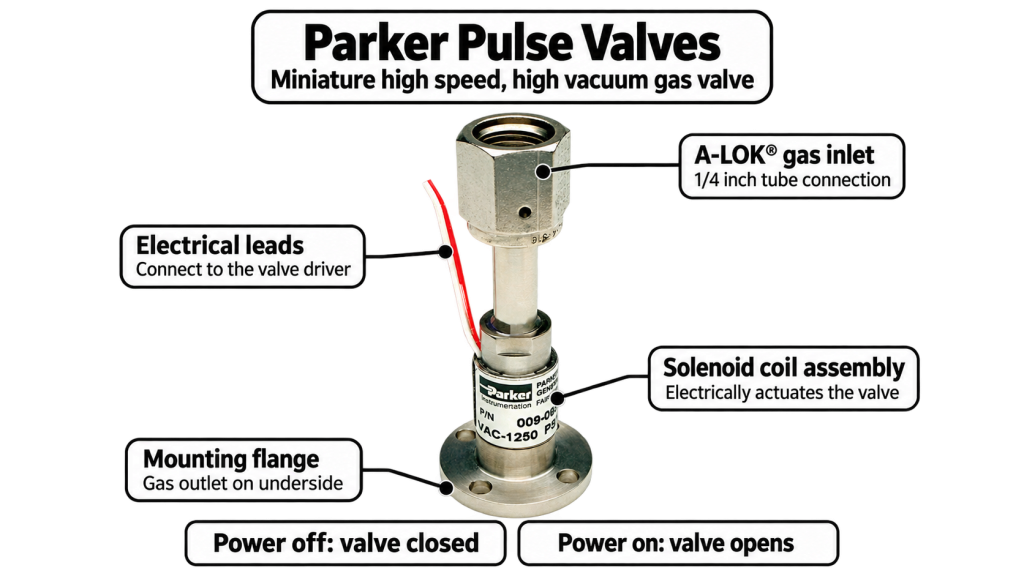
Fast gas switching and low leakage for OEM analytical instruments
As a supplier of Parker precision fluid control products, Air Engineering Group (AEG) brings practical experience in specifying their valves for medical and analytical OEM solutions.
Parker Pulse valves are miniature, two way, normally closed solenoid valves for fast gas admission into analytical and high vacuum systems. Energising the coil opens the gas path, whereas removing power closes it. The series also combines rapid switching, low published helium leakage, and stainless steel construction.
The documented application is gas pulse generation for laser spectroscopy. For OEM designers, valve selection depends on the gas, inlet pressure, downstream vacuum, orifice, and electrical drive. These factors therefore determine how the component performs within the finished instrument.
How does a Parker Pulse valve control gas admission?
The electromagnetic coil moves the armature to lift the internal poppet from its seat, opening the normally closed gas path when energised. A timed electrical command admits gas into a connected chamber or analytical flow path, while the spring returns the poppet to its seat when power is removed.
The resulting gas pulse depends on pressure differential, orifice size, gas properties, driver behaviour, and connecting volume. Allow for valve opening and closing delays, and check the pulse at the intended measurement point, since tubing and chamber geometry can alter its shape and timing.
| Electrical state | Valve function |
|---|---|
| Coil deenergised | Gas path closed. |
| Coil energised | Gas path open. |
Synchronise valve actuation with the instrument’s measurement sequence, allowing for opening and closing delays under the intended operating conditions.
Applications in gas analysis and vacuum instruments
Parker identifies laser spectroscopy gas analysis as a typical Pulse valve application. Brief gas admission can be coordinated with an instrument’s measurement sequence, while closed valve leakage is relevant to maintaining its downstream vacuum.
| Application | Role to assess |
|---|---|
| Laser spectroscopy | Gas pulse generation in the documented Parker application. |
| Analytical and research equipment | Timed gas admission into compatible vacuum chambers or measurement paths. |
| Life science and medical analytical instruments | Suitable gas analysis subsystems requiring fast switching and defined leakage performance. |
The wider instrument examples require application assessment. Specify the actual gas composition and operating conditions, including any cleaning or purge media, before deciding whether a particular configuration is suitable.
Why specify Parker Pulse valves?
Specify Pulse Valves with Confidence
Pulse valves combine fast switching, low published helium leakage, and defined orifice, voltage, and material configurations for demanding gas control. Their published specifications help designers assess pressure limits, gas compatibility, electrical drive, and mechanical integration before prototype testing.
For procurement teams, these documented configurations provide a clear basis for identifying the correct part, confirming technical requirements, and maintaining a consistent specification from development through production.
Fast switching with defined drive conditions
Parker publishes a cycling response of less than 2 ms and identifies faster operation with its IOTA ONE driver. The achievable result depends on the valve, drive settings, and operating conditions, so assess electrical timing alongside the required gas delivery.
Published helium leakage testing
The published leak rate is 1 × 10⁻⁷ cc/sec/atm helium, and Parker states that valves are 100% leak tested. This provides evidence for vacuum circuit evaluation. Check leakage through the assembled instrument as well, including fittings, seals, and connected hardware.
Construction and connection choices
Parker uses passivated stainless steel construction, with listed Vespel or PTFE poppet configurations and FFKM seals. The listed valves combine a 1/4 inch A-LOK inlet with a flange outlet. Certain variants include an exit cone, which Parker states improves exit stream uniformity.
Match the orifice to pressure and vacuum requirements
The published vacuum capability extends to 1 × 10⁻⁵ Torr. Maximum pressure depends on the selected orifice, so specify the required inlet and outlet conditions together.
A larger orifice changes gas admission and may affect the vacuum load. Choose it against the required pulse and available pumping capacity. Confirm flow direction, fittings, flange dimensions, and chamber interface using the selected part’s drawing.
Parker Pulse valve pressure ratings depend on orifice size, so check the published limits below against your required inlet pressure and downstream vacuum conditions.
| Orifice diameter | Maximum pressure | Published bar equivalent |
|---|---|---|
| 0.004 inch / 0.10 mm | 1250 psi | 86.2 bar |
| 0.020 inch / 0.51 mm | 1250 psi | 86.2 bar |
| 0.031 inch / 0.79 mm | 1250 psi | 86.2 bar |
| 0.039 inch / 0.99 mm | 750 psi | 51.7 bar |
Select the electrical and material configuration
Parker’s ordering table lists 20 VDC configurations with Vespel poppets and FFKM seals, and 28 VDC configurations with PTFE poppets and FFKM seals. Confirm the exact part rather than assuming every voltage and material combination is available.
| Listed coil voltage | Published power | Published current |
|---|---|---|
| 20 VDC | 12.1 W | 606 mA |
| 28 VDC | 11.2 W | 400 mA |
The datasheet describes IOTA ONE as controlling one valve at a time, so assess driver requirements for instruments containing multiple valves.
The published operating environment is 4 to 105 °C, with coils rated for continuous duty. Check heat generation, driver settings, and duty cycle inside the instrument. Parker recommends filtration of 40 µm maximum. Review gas compatibility across the entire wetted path, and obtain internal volume information where it affects the design.
The above component specifications come from Parker’s Pulse Valve datasheet.
Learn more about Parker Miniature Valves and Components
Specify with confidence from prototype to production
Achieve the right configuration for procurement
Provide the exact Parker part number alongside orifice diameter, poppet and seal materials, coil voltage, inlet and outlet porting, and driver requirements. Include any required exit cone, mounting dimensions, and chamber interface details.
For development enquiries, provide sample quantities, gas composition, inlet pressure, target vacuum, pulse duration and frequency, and the qualification timetable. For production sourcing, include forecast volumes, delivery requirements, technical documentation, and agreed restrictions on component substitutions.
Assess acquisition cost alongside driver hardware, assembly time, qualification, and maintenance. Confirm lead times, current availability, and service kit compatibility for the selected configuration, including replacement seal materials.
Discuss your OEM gas pulse requirements
AEG’s OEM Fluid Technology Division combines practical experience in medical and analytical fluid control with detailed knowledge of miniature valve specification, material compatibility, and system integration. Our team can guide component selection and assembly development, considering inlet pressure, downstream vacuum, orifice size, poppet materials, electrical drive, and gas pulse performance.
Share your circuit schematic, gas composition, inlet pressure, target vacuum, chamber volume, required pulse duration and frequency, electrical supply, and expected quantities so we can assess your requirements and recommend suitable options.
Browse the Parker Pulse valve range, or contact Air Engineering Group on 01342 826488 or email info@aegroup.uk.com to discuss your medical, analytical, or life science liquid control application.
Find the right Parker valve for your OEM medical or life science application with guidance from Air Engineering Group. Whether you have a part number, a specification, or a fluid control challenge to solve, we can help you assess suitable options and move your project forward.
From selecting and specifying valves for prototype equipment to procurement and after sales support, AEG works with your engineering and purchasing teams to clarify requirements, address integration challenges, and match valves to your application.
Tell us about your application using the form below. Share the details you have, even if your requirements are still developing, and our team will help you identify the next step.